
Pioneering the Future
Better Outcomes for Patients


April 20, 2026
From finding more effective treatments for common diseases to making doctors’ visits more productive, patient health can be improved in countless ways. Scientists at U of U Health seek out these opportunities, working in both labs and clinics to find creative solutions to big problems. Their accomplishments include:
- Identifying better treatments for prostate cancer to extend the survival of patients with metastatic disease
- Engineering an antibody that can neutralize a broad range of coronaviruses, a potential tool to prepare for the next pandemic
- Developing an easy-to-use device for continuous delivery of antibiotics to combat stubborn infections
- Creating tools for educating high-risk patients about stroke prevention and involving them in decisions about their care
This work improves lives right now—and makes us better prepared for health challenges in the future.

Better Treatment for Prostate Cancer
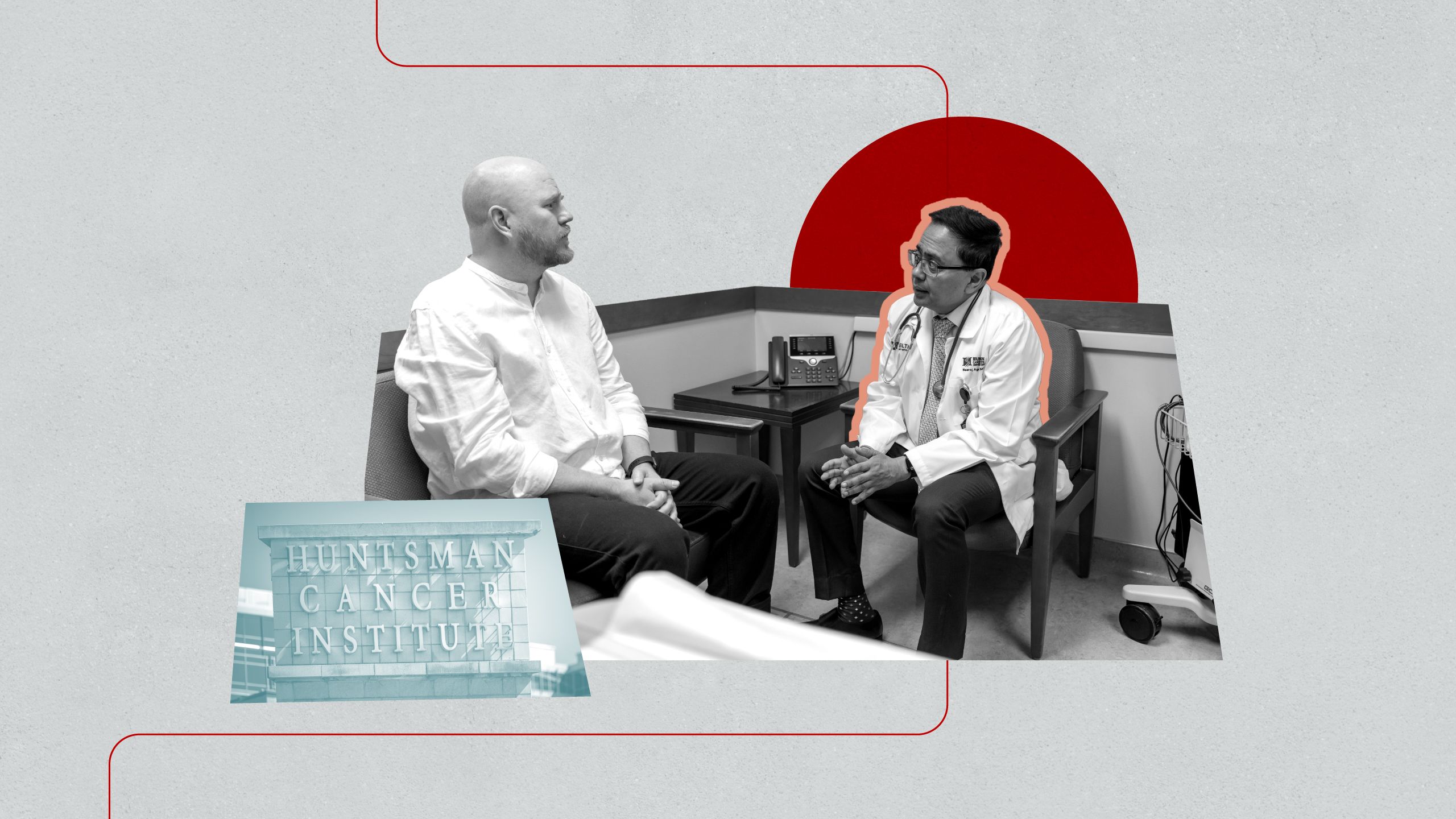
Prostate cancer is the second most common cause of cancer deaths for men in the United States. Worldwide, more than a million new cases are diagnosed each year. Treatment often includes drugs that rein in the cancer by blocking hormones that spur its growth. But as the disease progresses, many tumors become less sensitive to this type of treatment. Metastatic prostate cancers are aggressive and difficult to treat.
Neeraj Agarwal, MD, an oncologist and physician-scientist at Huntsman Cancer Institute and professor of internal medicine at the Spencer Fox Eccles School of Medicine at the University of Utah, wants better options for patients with metastatic prostate cancer. “I want my patients to be able to enjoy life while being treated for cancer,” he says.
Based on laboratory studies, Agarwal and others suspected that an enzyme called PARP might help prostate cancer cells resist hormone therapy. So he co-led a global clinical trial exploring whether adding a drug that inhibits PARP to the standard therapy enzalutamide could improve outcomes for patients.
More than 1,000 patients participated in the trial at hundreds of hospitals and clinics worldwide. Agarwal and his colleagues found that the new drug combination stopped the growth of hormone-resistant prostate cancers (also known as castration-resistant prostate cancers) for a longer period than enzalutamide alone. Based on their findings, the U.S. Food and Drug Administration (FDA) approved the combination therapy as a treatment for metastatic castration-resistant prostate cancers with certain genetic mutations in 2023.
More recently, the team has found that the treatment extends survival for patients with metastatic hormone-resistant prostate cancer, regardless of whether those mutations are present or the type of mutations. “Clinical trials help us find better cancer treatments with fewer side effects,” Agarwal says. “Having a new, well-tolerated combination of medications that significantly improves survival rates is terrific news for our patients.”


Evolution-Resistant Antibodies
In the first years of the COVID-19 pandemic, a specific type of drug—monoclonal antibodies— were literal lifesavers. Before vaccines were available, researchers had engineered antibodies that could block the virus that causes COVID-19 to prevent infection or reduce the severity of illness. But as the virus evolved, these drugs stopped working. There is only one preventive—and zero therapeutic antibodies—available against the SARS-CoV-2 variants that circulate today.
Rather than trying to keep up with a constantly changing virus, School of Medicine biochemist Tyler Starr, PhD, has been searching for an antibody that the virus can’t escape. Antibodies work by latching on to specific sites on the virus. Resistance arises when those spots change, leaving the antibody with nothing to hold on to. Starr and collaborators at Vir Biotechnology and the University of Washington have developed an antibody that tolerates variability in its target region, allowing it to tightly bind not just to SARS-CoV-2 but to dozens of related viruses.
The group is the first to show that a monoclonal antibody can be both potent and active against a broad range of SARS-related coronaviruses. That antibody neutralized every SARS-CoV-2 variant the team tested. It was equally effective at stopping dozens of related coronaviruses that infect bats but not humans. The results indicate that the antibody could be useful if, in the future, another SARS-related virus evolves the ability to infect humans.
The feasibility of engineering broadly acting antibodies is encouraging news for pandemic preparedness. “We often know the type of virus that might become a future zoonotic outbreak, but within that flavor of virus we don’t know which exact strain will be the one that becomes the problem,” Starr says. “A vaccine response takes time, and monoclonal antibodies are a vital stopgap in that interim period.”


Controlling Stubborn Infections
When bacteria settle into a wound or surgical site as a microbial community known as a biofilm, the infection can be notoriously difficult to treat. Microbes in a biofilm hibernate inside a protective matrix, largely out of reach of systemic antibiotics, allowing the infection to stubbornly persist.
Treating biofilm infections requires strong local antibiotics, delivered over a prolonged period—a difficult combination to achieve. A new drug delivery device developed by Dustin Williams, PhD, a professor, and Nicholas Ashton, PhD, a research assistant professor, both in the Department of Orthopaedics at the the School of Medicine, does exactly that. Their Purgo Pouch is refillable and allows antibiotics to diffuse through a rate-controlling membrane directly into the site of infection. It can be used without complex medical equipment, making it practical for use in conflict zones or disaster relief.
In recognition of its potential to address an important medical problem, the FDA designated the Purgo Pouch as a Breakthrough Device, which accelerated several aspects of review and development. First-in-human clinical trials are anticipated to begin in mid-2027. “My goal is to heal people,” says Williams. “The rates of infection for orthopedic procedures have gone unchanged for 50 years. The need is there.”
Meanwhile, the new technology is already changing infection management for veterinary patients. Horses, cats, and dogs have all benefitted from the Vetlen Pouch developed by Williams and Ashton, which uses the same rate-controlling membrane to deliver continuous medication to infection sites for up to 30 days.


Doctors and Patients Deciding Together
Millions of people in the United States live with atrial fibrillation (AFib), an abnormal heart rhythm that causes blood to pool in the heart, where it can form clots. That’s dangerous, because when a clot leaves the heart and travels to the brain, it can cause a stroke. Fortunately, this risk can be significantly reduced by taking anticoagulant medications.
People with AFib have several options to reduce the likelihood of blood clots. But each of these has drawbacks, and many people who are prescribed oral anticoagulants never take them. Medications that slow clotting inevitably cause patients to bleed more easily, and some require frequent blood tests to ensure dosing is safe and effective. Some newer drugs require less monitoring but are more costly for patients. So what works for one person may not be the best choice for another.
Two tools developed by Elissa Ozanne, PhD, an associate professor in the Department of Population Health Sciences at the School of Medicine, help doctors and their patients make treatment decisions together. To help people prepare for conversations with their doctor, Ozanne developed interactive educational materials that can be used at home or in a doctor’s waiting room. A second tool facilitates patient-provider conversations during clinic visits.
In a clinical study, these tools improved patient knowledge and shared decision-making. Angela Fagerlin, PhD, the chair of population health sciences, who also directs U of U Health’s DECIDE (Decision-making and Choices to Inform Dialogue and Empower AFib patients) Center, says that should lead to better health outcomes. “If people don't feel engaged in the decision-making process, they are less likely to see the benefits of treatments,” she says.
Pioneering the Future: Stories of Discovery & Innovation at University of Utah Health
Produced by Kyle Wheeler & Julie Kiefer
Written by Jennifer Michalowski
Editing by Julie Kiefer & Nick McGregor
Layout by Kyle Wheeler
Designs by Modern8
Photography by Charlie Ehlert & Emily Bade


 Built with Shorthand